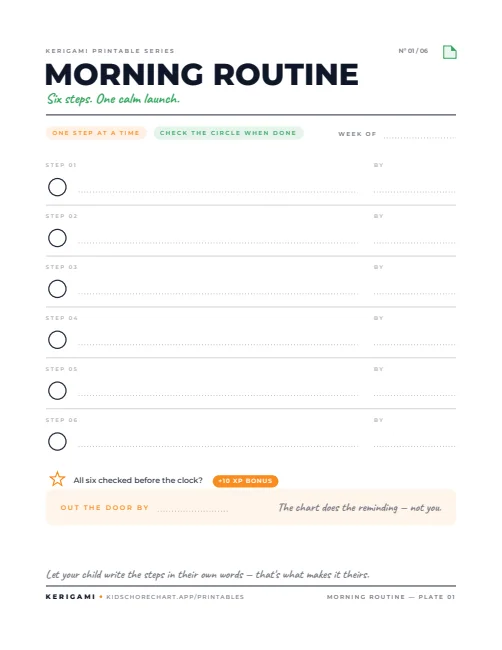
Morning Routine Chart
Six write-in steps, one time anchor, and a bonus for beating the clock. The chart does the reminding — not you.
Six routine and chore charts built around how ADHD brains actually work — free, ink-light, and ready to print. No email required.
Designed by Welbr DosSantos — former child therapist · Updated July 2026
Six write-in steps, one time anchor, and a bonus for beating the clock. The chart does the reminding — not you.
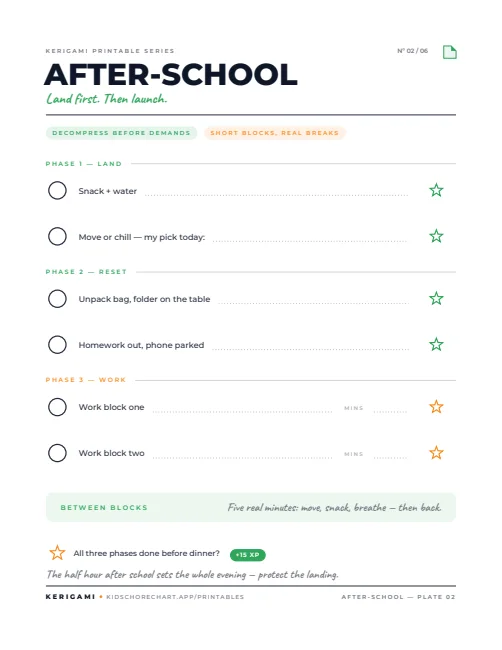
Land, reset, then work — with decompression built in before homework and real breaks between work blocks.
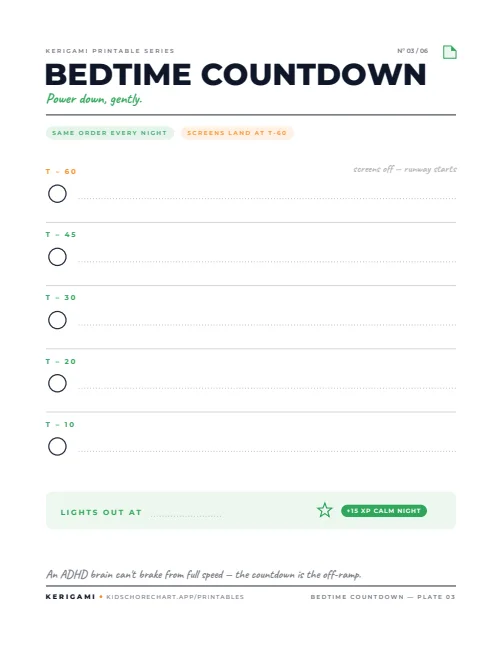
A T-minus off-ramp from full speed to lights out, starting with screens off at T-60.
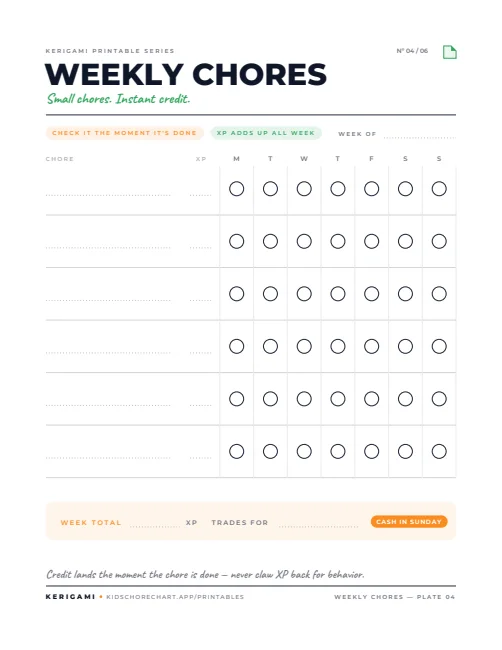
Six chores, seven days, and an XP column so credit lands the moment the chore is done.
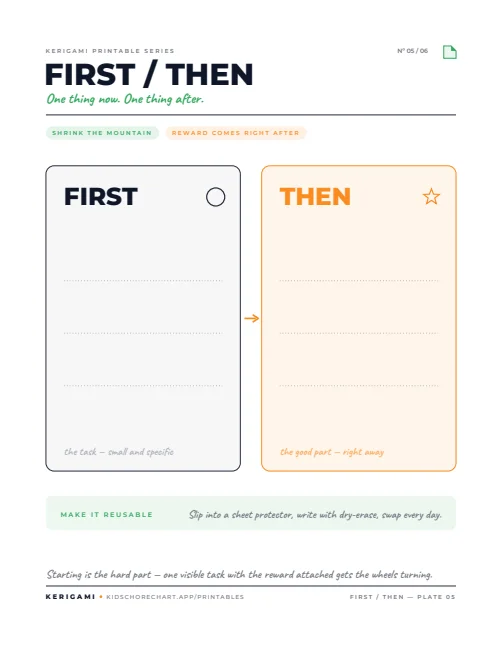
One task, one reward, nothing else on the page — the classic task-paralysis breaker. Reusable in a sheet protector.
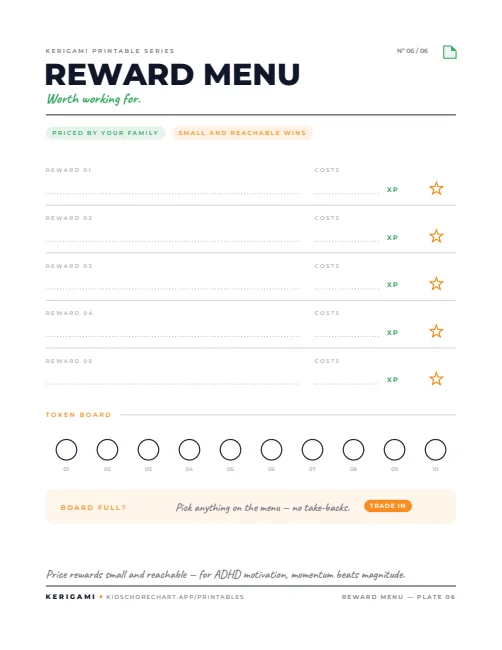
Five rewards priced by your family, plus a ten-token board to fill — small, reachable wins over distant jackpots.
Most printable chore charts are decoration — twenty tasks, tiny boxes, and a smiley sun. These six follow the same behavioral principles as the Kerigami app, because a chart for an ADHD child has one job: make the next step obvious and the credit immediate.
Every paper chart has a shelf life with an ADHD child — usually two to three weeks, and it isn't your fault or theirs. Novelty is the fuel, and paper can't refresh itself. That's why sticker charts die on schedule, and it's why this set gives you six charts instead of one — rotation is the cheapest novelty there is.
When rotating paper stops being enough, that's the exact problem the Kerigami app exists to solve: chores become quest cards, XP lands instantly, and the whole system re-skins itself with themes your child picks — so the novelty renews without you redesigning anything. The free plan covers one child, and these printables stay free either way.
Yes — every PDF on this page is free, with no email signup and no watermark tricks. Print as many copies as your family (or classroom) needs. They're US Letter size and deliberately ink-light, so they print cheaply on any home printer.
Roughly ages 4–12, depending on the chart. The First/Then board works for the youngest kids (and for the hardest moments at any age). The routine charts suit early readers and up — and every chart has write-in lines so you can pitch the words at your child's level.
Pick the chart that matches the hardest hour of your day. For most families with ADHD kids that's the morning routine; if getting started on anything is the battle, begin with the First/Then board instead — it's the smallest possible version of structure.
Expect it — that's ADHD novelty decay, not failure. Rotate to a fresh chart, let your child rewrite the steps, or change the rewards. When paper stops being enough, that's exactly the problem the Kerigami app was built to solve, with rotating themes and instant XP that keep the system feeling new.
Kerigami turns these same principles into a quest system your child actually asks to use — free for your first child, on iOS, Android, and the web.
Try Kerigami free